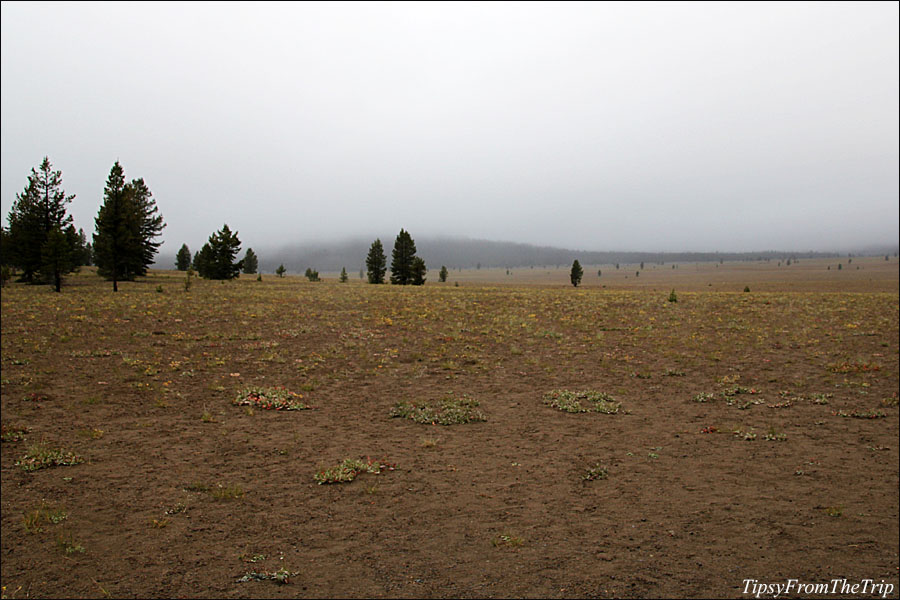
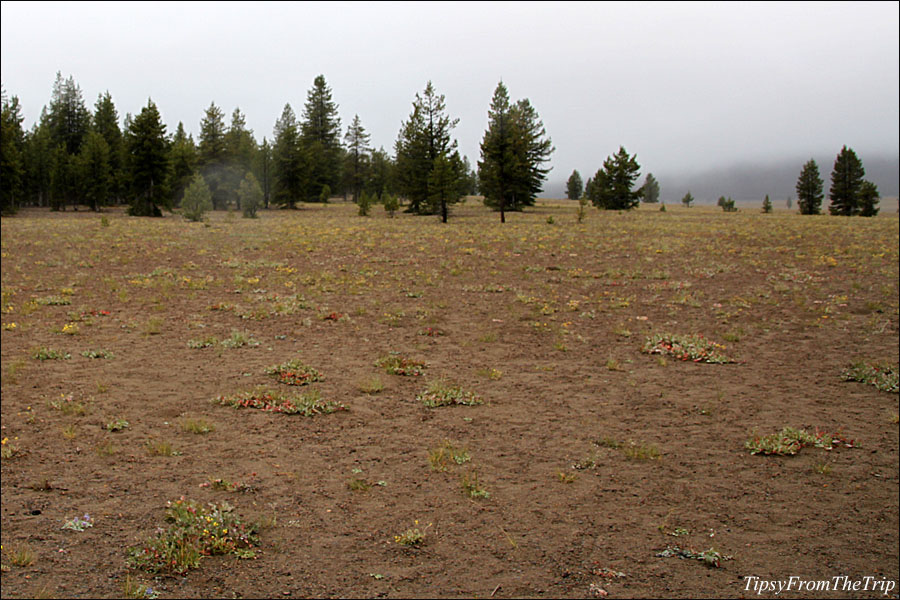
After we left Crater Lake on our first visit there, we exited the National Park via the North Entrance Station. As we drove through the rain and the fog, we got to a large clearing that looked like a large playground. I guessed it was the Pumice Desert that I had read about. This desert can be called a by-product of what might have been one of the biggest volcanic eruptions of the Cascade Mountains.
Remember the story of Mt. Mazama? Of how it grew in volume and the violent explosion that caused the summit to crash leaving a gaping caldera in its place? (If you missed the previous post, it might be a good idea to set your eyes on that natural wonder called Crater Lake. You won’t regret it, I swear. :))
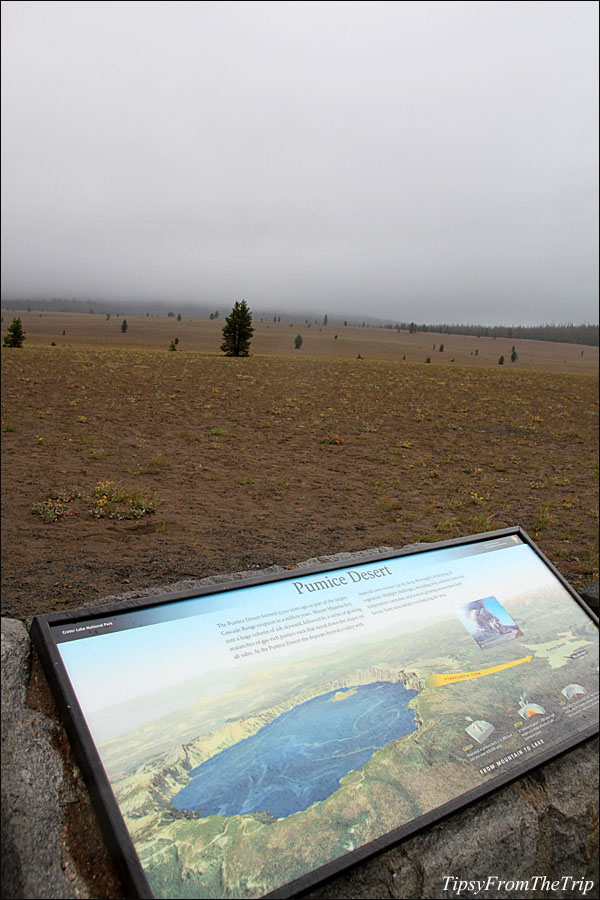
How the Pumice Desert came about —
When Mt. Mazama erupted, it threw large amounts of ash up into the air, which then settled several miles away from the volcano. Along with that, a good part of the ash and pumice that flowed down the slopes of the mountain were deposited in a valley nearby. People who have been studying this part of the Cascades and the many volcanoes on it, say that that deposit is at least a 100ft. one. Even after almost 8000 years, the valley that was turned into flat land — now called the Pumice Desert — is quite devoid of vegetation.
The thick layers of pumice seem to have made the land very porous. It’s inability to retain water makes it difficult for plants to thrive there. That almost-barren land is quite a desert in the middle of an area that was able to regrow some trees after the epic devastation that came about with Mt. Mazama’s eruption.
If you visit Crater Lake National Park in Oregon, the Pumice Desert is a must-stop POI because its story is so inseparable from the story of Crater Lake.
Pointers for the trip to the Pumice Desert
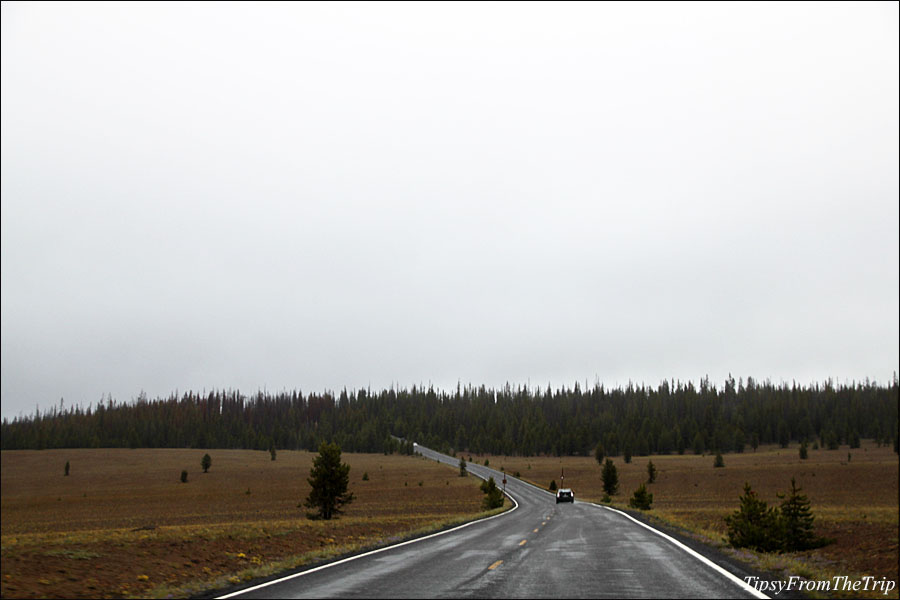
- Volcanic Legacy Scenic Byway passes right through this desert.
- If you plan on entering Crater Lake National Park through the north, you will see the Pumice Desert first. It is on the way to Crater Lake.
- If you’ll be taking the South Entrance to the park, you can follow the Rim Drive till it forks off. Then, take the route to the North Entrance Station. The Pumice Desert is around 10 miles away from the Rim.
- If you are visiting in the winter months, you may not be able to see the Pumice Desert. The Rim Drive and the road that connects the Rim Drive to the North Entrance will be closed in winter. There could be closures when there is too much snow in the area, too.
You might also like:
Volcanic Sites on Tipsy from the TRIP
Volcanoes of the Cascade Range


What an interesting post. I never knew about this. Thanks for the share.
Worth a Thousand Words
Thank YOU M.
Make sure you stop here when you visit Crater Lake. 🙂
Have a good week. 🙂
Intriguing place and post ~
Happy Day to you,
A ShutterBug Explores,
aka (A Creative Harbor)
Volcanic sites are very fascinating, aren’t they?
Happy Day to you too, Carol. 🙂
This is amazing. Love landscapes shaped by volcanoes and flowing lava/ash,… I wonder what knd Of bio-diversity is found here
It’s an interesting place. Ah! the things travel shows us. 🙂
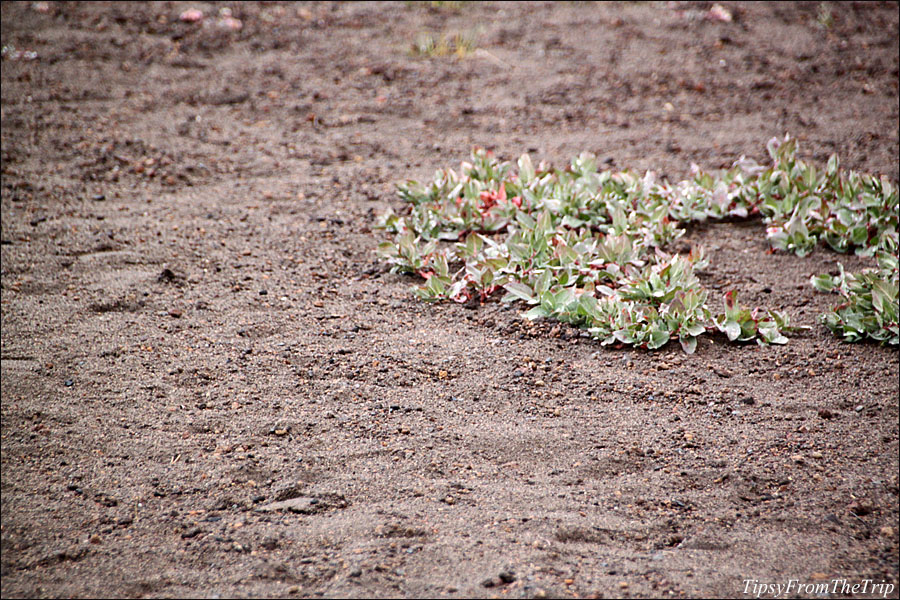
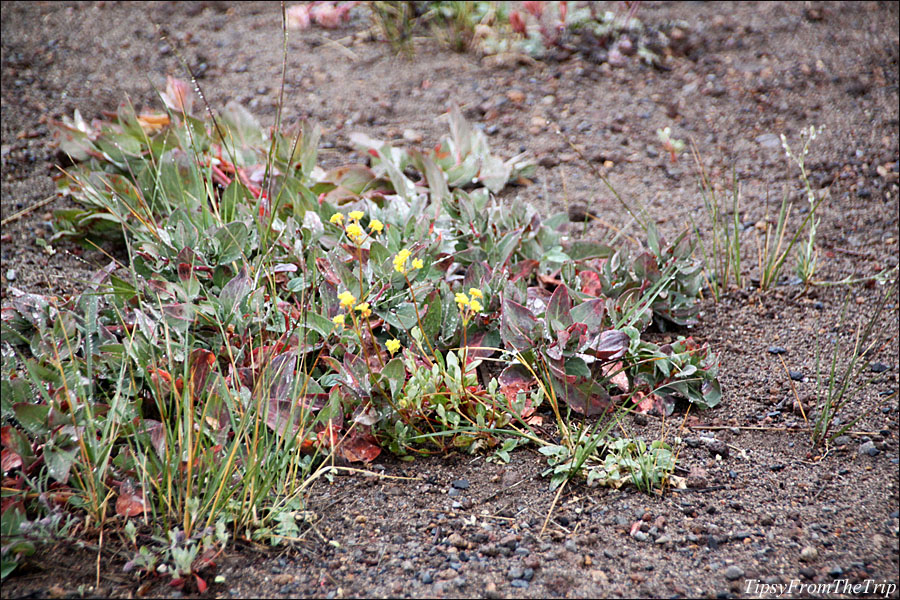
A few plants have started coming up here but I guess they won’t be able to withstand the snow in winter. I’m thinking it’ll be a while before it gets all green.
There are trees and plants around the pumice desert so animals like elk and coyote that are comfortable even in cold temperatures are found here.
I visited Crater Lake back in the 1980s. I don’t recall visiting this desert but your last photo has me thinking we took that road. I wonder if eventually the pumice desert will be a forest floor.
You might have passed this place if you went north after seeing the lake, Su-sieee. Considering the area has started seeing some plant life in it, it could be a forest some time in the future.
Thank you for stopping by, Su-siee. 🙂
It was nice to know how the place has come into exist, beautiful captures.
To think that volcanoes can also create landscapes like this, is interesting, right?
Thank you, Jyotirmoy. 🙂
Wow – fascinating and beautiful!
Indeed. Thank you, Lady Fi. 🙂
Stunning views.
🙂
Informative post on Pumice Desert ? Dee. Beautiful captures too ? Thanks for sharing ?
Thank you, Sachin. 🙂
Never heard of such a desert. Thanks for that, Divya. That’s a lovely last frame.
🙂 Now you have.
Thank you for coming this way, Nomad. 🙂
Roads!! <3
I know you love roads, too. 🙂
Another reason to visit the Crater Lake area! I have never heard of a pumice desert, but I would love to see this. I went to Crater Lake as a child and I’ve always wanted to go back.
It’s an interesting piece of land, Sharon.
You should see it the next time you go that side. It’s really close to the lake, itself. 🙂
Have a good weekend. 🙂
Knew about the pumice stone.
Thanks for introducing the Pumice desert.
Our world is so interesting!
Great pics!
I’m happy I could share a little something about the pumice desert. Our world sure is a very interesting place.
Thank you so much, Anita. 🙂
Interesting and so beautiful! Loved knowing about Pumice Desert Divya, the little life growing amidst the bareness catches my eye. Lovely pictures.
Indeed. Volcanic sites are so fascinating. Those little plants in the pumice desert do stand out. I’m pretty sure they die when snow takes over the landscape. It sure looks like survival there is quite an ordeal for these plants. But then, I’m sure that in due course this place will see some vegetation that will be there to stay.